

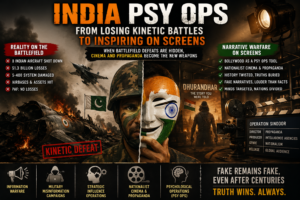
India Psy Ops from Losing Kinetic Battles to Inspiring on Screens

Fifth-generation warfare (5GW), or hybrid warfare, is a multifaceted war conducted largely without men or weapons, but through the manipulation of information, cyberbullying, and social engineering. Sun Tzu (Chinese military general, strategist, and philosopher) defined this metaphor as the supreme art of war, which subdues an enemy without a battle. However, no matter how spectacularly direct combat fails, the defeated nation rewrites reality by transforming loss into legend and shame into cinema. That is the paradox of 5GW: the winner of the war turns into the enemy on the screen, while the loser of the war spends billions on misinformation. 

Likewise, from May 7 to 10, 2025, India lost eight aircraft (as per the DG ISPR Press briefing on May 7, 2026) and incurred a collective financial loss of $1.3 billion. So Psychological Operations (Psy Ops), as weapons of 5GW, were the only way out to counter the humiliating defeat. So, India’s most favorite toy, their “cinematic front” has been producing big budget movies like Dhuraindher to defame Pakistan by reviving Karachi’s history 20 years back.  But, the filmmaking of the Dhuraindher series raised some igniting questions, such as;   

Why did New Delhi have to resort to Psy Ops by stoking the old conflicts of  Karachi now? Is there anything new to add to the dish other than lying and coming to terms with one’s guilt in those days?  Despite ranking 157th out of 180 countries in the World Press Freedom Index reported by Reporters Without Borders (RSF), why are Indians trailing behind even neighbors like Nepal, Sri Lanka, and Bangladesh in press freedom? Why have Indian authorities registered over 1087 fake news reports against Pakistan in the first 6 months of the war? Most importantly, why is India now acknowledging its role in the chaos in Karachi from 1990 to 2008? Are movies like Dhurainder, again, a blunder that highlights India’s fake narrative to gain regional hegemony in an extremely bogus manner? 

This blog dissects India’s strategic pivot from kinetic defeat to cinematic psychological warfare, exposing how Bollywood blockbuster Dhurandhar serve as narrative bandages for a traumatised nation, while intelligence agencies re-ignite Karachi’s ethnic wounds to destabilize Pakistan again.The following statistics may answer every single one of these questions.
8-0 Aerial Victory: Statistical Reality of May 2025

According to independent defense assessments by both British and Swiss analysts, Pakistan achieved a decisive tactical victory on the first night of the war, as there were no reported PAF losses in official public reports. In response to India’s “Operation Sindoor” that targeted PAF air bases on May 8 and 10, Pakistan launched “Operation Bunyan-un-Marsoos” on May 10th, which included raids on BrahMos munitions stored in Beas and Nagrota, damage to Pathankot, Jammu, and Udhampur airfields, and destruction of the Indian S-400 system.  Pakistani drones conducted surveillance over New Delhi. No Pakistani aircraft was lost or failed its mission. According to PAF official statements, the destroyed assets include:

Aircraft Type

Quantity

Unit Cost (USD)

Total Value (USD)

Dassault Rafale

4

$288 million

$1.152 billion

Sukhoi Su-30MKI

1

$50 million

$50 million

MiG-29UPG

1

$48 million

$48 million

Mirage 2000

1

$40 million

$40 million

Heron Drone

1

$10 million

$10 million

TOTAL

8


$1.30 billion


Indo-Pak War: Who paid the highest price in 2025

Based on figures on losses reported by other countries, India accounted for the lion’s share of losses, as it had the largest economy, the highest military spending, and the greatest exposure to the stock markets. 

Source

India’s Loss

Pakistan’s Loss

Key Observation

SSRN Academic Paper

~$9–10 billion

~$2 billion

Combined market cap loss of $9–12 billion; India’s share ~80%

Moody’s Ratings

Stable economy, minimal impact

External financing at risk

India’s limited trade with Pakistan insulated its economy

Bloomberg News

More at stake due to GDP size

Smaller relative loss

India’s GDP is 8x larger, so absolute losses were higher

Foreign Affairs Forum

$670M/day military; $17.8B/day broader

Insignificant

Broader economic losses primarily attributed to India

IPAG Analysis

$400+ billion (projected monthly)

$100 billion (projected monthly)

India would bear 80% of a prolonged conflict’s cost

Bangladesh Guardian

~$83 billion

~$4 billion

India’s total loss ~95% of combined total during the conflict


The Collapse of India's Information Warfare: "Godi Media" Exposed

The Initial Disinformation Wave (May 7–10, 2025): Indian news networks fabricated fake stories of the arrest of Pakistan’s army chief, destruction of forward airbases, Karachi port, capture of Islamabad and the forced surrender of PM Shehbaz Sharif. When General Asim Munir was promoted to Field Marshal, Prasar Bharati declared that a coup had occurred in Pakistan. Whereas, Chief of Defence Services of India had to acknowledge 15% debunking of India’s fake news during its operational time. Global Backlash references are given as:


Source

Finding

Washington Post

Frankenstein’s monster” of unchecked misinformation

IFJ

Channels engaged in “theatrics of war

BOOM

68% of fact-checks related to Operation Sindoor; 69 of 101 total

Content Breakdown

64.4% old footage (Gaza/Iran/Sudan); 13 AI deepfakes

False Content

71.3% false, 12.9% fabricated, 9.9% misleading, 5.9% manipulated

CNN Statement

Viral graphic showing India’s losses was “fabricated”


Hybrid Warfare: India's Only Path To "Victory

India went from believable lies to unprovable chaos after the media debacle in May 2025. Indian strategists are shifting gears to ‘Narrative warfare’ as they were defeated in the skies, their S-400 systems were damaged, and their forward airbases were hit. Indian channels “abandoned all pretense of giving facts” and “descended into a frenzy,” the International Federation of Journalists reported. This illustrates how digital manipulation is outpacing traditional fact-checking.

Video game clips were shown as genuine attacks. The video of a car crash in Philadelphia (January 2025) was released as a video of a bombing in Karachi port. The Karachi Port Trust (KPT) said the port was “functioning normally”. It was even a deep-fake video of Donald Trump, in which he is manipulated to support Indian military action against Pakistan.

The Citizens for Justice and Peace (CJP) had made formal complaints against six big Indian television news channels for “serious ethical lapses”.Teesta Setalvad, the secretary of CJP, said the channels had completely abandoned their responsibilities as neutral news broadcasters. “Instead, they became propaganda collaborators,” 

Dhurandhar: Box Office Gold but Battlefield Grit

India’s total air losses ($1.3 billion) equal nearly nine times Dhurandhar’s box office collection. India’s daily war cost ($16 billion) exceeded ten times the entire annual bilateral trade ($2.5 billion). The disparity is staggering: celluloid escapism cannot mask kinetic catastrophe.

Metric

Value

Worldwide Collection

Rs. 1,253.83 crore (~$150 million USD)

Performance

All-Time Blockbuster

Comparison

Less than cost of one Rafale ($288M)

Theatrical Run

Several weeks

The following viewpoints are the stories behind the camera that explain why India is so hasty to invest more of its budget not in defence but on the Cinematic front.

1. Strategic Need For Dhurandhar (Late 2025–2026)

The Indian political leadership has failed to provide a satisfactory narrative about face-saving as a result of the ceasefire urged by the Indian government after the massive destruction in New Delhi on May 10, 2025. Visionary leadership of Narendra Modi is desperately trying to turn Operation Sindoor’s defeat into ready-made nationalistic movies; Dhurandhar manufactures the victory that Indian Generals could not deliver on the battlefield. The movie is used to psychologically reconstruct the domestic audience. Cinema is the place where India wins and empathizes with the Pakistani citizens, as whatever they do, it’s a war against terrorism: Alas, old wine in a new bottle.  

2. Adding Fuel to Fire on Conflicts in Karachi Again

Indian intelligence is building up again ethnic tensions in Karachi among Sindhies, Pashtuns, Muhajirs, and Balochs with the help of “Namaloom Afraad” proxy groups. Paradigm Shift has strategically and comprehensively analyzed the hyper-nationalistic Indian film, “Dhurandhar”, as  primary means employed for this goal consists of targeted assassinations, economic disruption, and rapidly disseminating incendiary reading material; ultimately, these activities are initiated to replicate, in Karachi, the level of destruction inflicted upon cities across the globe due to urban warfare in the 1990s. ultimately forcing Pakistan to exhaust its security resources internally rather than focusing on its borders. 

To Sum Up,

The Indian government failed to provide reasons why India opted for a ceasefire after the May 10, 2025, PAF dogfight in the skies of New Delhi. South Asian security dynamics remained unaddressed by both countries, which requires serious strategic communication. Cross-border information warfare, military misinformation campaigns, and strategic influence operations have dramatically transformed into nationalist cinema and propaganda; not out of rage, but as a distraction.

How long will Indian journalism and the silver screen distort facts and visualize their victory? How long will Retired Major Gaurav Arya (who believes in Adolf Hitler and his Psy Ops religiously as a successful warfare strategy) and his ilk keep boot polishing the Indian government through emotional rhetoric, selective narratives, and unverified assertions of victory?    

Fake remains fake, even after centuries

The answer to this question has been given in history. The same strategy was used by Adolf Hitler’s Nazi Germany: grandiose narratives, fake wins, psychological warfare and invincibility. Those fake stories were exposed and discredited by the world in 1945—yielding rubble, shame, and a lesson in blood. Propaganda is not a tool used to win wars. 

Truth always remains constant.

Then, in which century is Indian journalism living? The 21st century requires facts, not fabrications. But New Delhi wages yesterday’s warfare tactics today with obsolete weapons: cinematic fantasies, chaotic terror, and confessions in the form of denials. How long will the world be silent while the war scorecard speaks the truth more loudly? Box-office numbers or social media views cannot gauge the impact of India’s fake narrative success; rather, it is measured by its International Press Freedom Score.

Last but not least: For how many more decades will Indians need to realize the reality behind Adolf Hitler’s defeat? How long will they deny that relying more on hybrid war and cinematic Psy Ops is venomous to their own nation?  What lessons have they learned from the demoralized pride of Deutsche, whose centuries-old bravery was reduced to ashes after their unforgettable defeat on the battlefield?

Recent post

Popular Articles

Quick Links

Informational Links

Contact

0328_8954641

Lahore Pakistan

© 2024 Powered by AXCESS

Scroll to Top