
The Great Unfolding: How Ancient Eschatology Is Shaping Today’s Geopolitics

Death has long stalked history, as all civilizations have produced some apocalyptic mythos: stories about cataclysm and redemption at the end of days. Mythos have been described as resilient, geopolitically significant, or aggressively mutating as those found in Judaism, Christianity and Islam. Between 2023 and 2026, something extraordinary happened: the apocalypse caught up with reality. Conflict after conflict erupted in the Middle East, climate change began to be described in biblical language. Russia emerged from its post-Cold War malaise yelling about Mother Russia and God (a national personification of Russia).

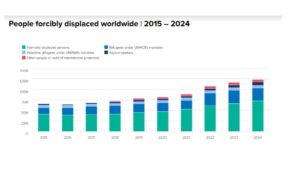
The statistics are quite staggering. The UNHCR recently reported a sobering milestone: over 117 million people are now displaced globally. From record climate disasters to the echo of war across continents, 2024 feels less like a series of isolated events and more like a collective breaking point.

China continued its inexorable rise, as robots became scary enough to start inspiring religious iconography. The future arrived, and an older way of thinking about the future began to inform real-world geopolitics like never before. 

If you’ve paid any attention to current events over the past few years, you’ve likely heard traces of references to Biblical End Times, the Rapture, Sunni-Shia strife, the Axial Age, Jesus Christ Second Coming, manifestations of the Imam Mahdi, Jewish voices prophesying about how the Messiah will return to Jerusalem, or why he won’t. While some of these voices have been extremist, many have not. 

Predictive lenses steeped in eschatological traditions—whether dispensationalism, Islamic teachings about the Mahdi, or Jewish ideas about the Messiah—are now shaping how world leaders and populations act, feel, and perceive with the world around them. If you want to understand what’s going on in the world today, you need to understand how these idea systems are playing a role. Welcome to Apocalypse Redux.

Is it Islamic apocalyptic predictions, Christian end-time prophecies or Jewish Messianic expectations that have you up at night?.  With all the daily drama in the world, the Biblical Book of Revelation may feel more familiar than the morning paper. If so, you’re in good company.

In a world of Hyper-globalization and belief systems, where does the lens of eschatology fit in? Is there a weight that these worldviews hold that we should be listening to? Or is there a reason that these prophecies can fall on such deaf ears?.

It might be because we are looking for a “why” that goes beyond the policy briefs. When we read about war in the Middle East, economic upheaval and climate change, are we experiencing instability in the world, or are we experiencing the unraveling of an ending?.

So, if you have been feeling that end times, it’s not just you. We are all having an identity crisis when it comes to making sense of a world that is spiraling beyond our control, and the three Abrahamic faiths have a lot to say about why.

Ancient Eschatology: The New Language of Our Times

Whether in the Middle East or social media forums around the world, Biblical/world prophecies are being compared to current events more than ever before. Millions of people around the world now use stories that were once familiar only to readers of the Bible to make sense of life.

Christians compare the current state of war and economic change to Bible prophecies of the Second Coming of Jesus and the tribulation period known as Armageddon. Many believe that these disasters are not mere coincidences, but rather part of the “birth pains” that will occur before Jesus returns to reign on Earth. By aligning present-day events with the End Times, many Christians are coping with current world affairs by tracking how many signs have occurred before Jesus returns.
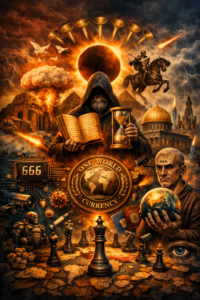
Similar to Christians, Muslims also share apocalyptic beliefs. As we approach the 14th century Hijri, and the year 1447 AH in the Islamic calendar, many Muslims are discussing the signs of Qiyamah (Islamic Doomsday). The return of Imam Mahdi and Isa (Jesus), as well as the deception of the Dajjal, are heightened as many countries around the world continue to destabilize, creating a wave of refugees and displaced persons. By correlating current events to the arrival of these figures, many Muslims view today’s disasters as just a glimpse of what’s to come when the Dajjal arrives.

Rounding out the three major Abrahamic religions, many Jewish people are also entering 5786 by reflecting on their beliefs about the Messianic Age and stories of Redemption. Jews around the world are approaching the 6th Millennium by reflecting on what the change in years means for the restoration of the nation of Israel and for healing the world. Like their Christian and Muslim counterparts, Jewish people are finding meaning within current events by seeing them as indicators of the Messiah’s arrival.

No matter the source of their pessimism—global warming, artificial intelligence, overpopulation—you name it—religious people around the world are searching for meaning by correlating current events to prophesied events of the End Times.

Conflict And Apocalypse: A Deep Dive Into Their Nexus

The post-2023 international order has become an infinite blur of Apocalypse narratives in 21st-century geopolitics, stretching from the Levant to the Caucasus and beyond. While politicians and pundits argue over whether this state of affairs is beneficial, the intersection of religion and global instability has noted what they believe is an apparent eschatological trend. Although the so-called US–China Cold War and great power competition have taken center stage, events are now routinely discussed against a mystical backdrop and within the apocalyptic vernacular.

We see this type of behavior with the ongoing Israeli–Iranian and Israeli–Palestinian conflicts, both of which are increasingly viewed as events that will culminate in Armageddon, or the Battle of Gog and Magog. These events are widely believed to precede the Second Coming of Christ, at least within the context of Christianity. As far as the Islamic narrative is concerned, violence and strife in the Middle East and the wider region are believed to precede the rise of Imam Mahdi and the return of Isa (Jesus) in the context of the last hour. The theological framing of the power struggle in the Levant has inevitably and naturally intensified and deepened these hostilities. From Israel to Europe and the US, the presence of such factors in political discourse is already contributing to a pronounced rise in ideological polarization on digital and social media.

At the same time, on the economic and energy security fronts, many of these voices have begun discussing the possibility of a complete breakdown of the existing global system. They use the words of both economists and those who see the twenty-first century as one of great transitions. In other words, the great unraveling is seen by many as part of a great shift in civilizational consciousness and values.

Social Media and the Rise of Apocalypse Content

The conflicts in the Middle East since 2023, the Russia–Ukraine war and global uncertainty have caused a significant increase in apocalyptic beliefs from religious, political, Information Warfare, and social perspectives. From a statistical standpoint, there were 123.2 million global displacements as of 31 December 2024, thereby a 6% increase from 2023 and double the amount from 10 years ago. As of June 2025, there are 117.3 million displaced people worldwide, including 67.8 million internally displaced people and 42.5 million refugees. Digital eschatology as a social media influence has led faith groups to believe that we are indeed living in the “last days”.
The largest sources of recent displacement are the Russia–Ukraine war, which, as of 2024, has internally displaced 3.7 million people in Ukraine. The crisis in the Middle East has contributed to regional instability, which threatens international security. The results of the war in the Middle East have been attacks on oil tankers in the Strait of Hormuz. As around 19% of the world’s petroleum passes through the Strait of Hormuz, any disruption to tankers has had a significant impact on global inflation. Religious perspectives on topics such as Israel, Palestine, Iran and Middle Eastern realignment are driving increased tension between world powers. Many wars and conflicts are often framed in religious terms within Christianity, Islam, and Judaism. This can fall under the concept of Eschatology, or the study of End Times. 

Certain events that have happened or are occurring are believed to be Bible prophecy becoming reality, such as worldwide wars, the rise of aggressive nations, migration crises, and a decline in moral ethics. As these topics become increasingly important in religious contexts, we are seeing more polarized ideological divides, stronger feelings of identity, and the moral equivalence of geopolitical tensions. This political conflict often puts countries at a standstill in peace negotiations because it makes compromise seem like going against one’s god or one’s civilization.

The Hidden Role of Eschatologies in Modern Culture

Eschatology offers comfort and relief to those faced with the chaos of the modern world. Times of great social upheaval, such as economic breakdowns, can leave people feeling out of control. End times beliefs allow people to see world events as part of God’s plan, which, in turn, helps them cope better with their situation and feel more in control. People feel more grounded and less guilty when thinking about disasters around the world if they believe they are justified within a divine plan that extends throughout history. 

Apocalyptic thinking can make people anxious. When people transform news stories into prophetic predictions, they thereby cause mass hysteria. As people continue to feel anxious about these news stories, they will feel as though there is an impending doom. Correlating events with the end times can leave people feeling overwhelmed and unable to think logically. Many times, when people are trying to make sense of world events, they stay online, refreshing their feeds. End times beliefs can cause people to fall prey to conspiratorial thinking and viral online content. 

When people believe a certain group is orchestrating all world events, they may distrust public officials and the scientific community. Oftentimes, people who convert to evangelical religions can become politically polarized. They may believe that all policies fall under one of two categories: right or wrong. Viewing world events through the lens of apocalypse can lead people to fear diplomacy, as they may see it as tolerant of evil.

To Recapitulate,

Eschatological readings and apocalyptic sensibilities throughout the Abrahamic faiths are arguably among the most salient forces at work in the world today. Dominating popular imagination and discourse online and across climate change narratives since 2023, it has provided a critical lens to interpret war and social ambiguity. In a world as connected as ours, the Apocalypse and its religious end-times are for millions of people the single dominant filter through which they make sense of their lives and the trajectory of the world we are building together.

In this context, Christian eschatology, Islamic eschaton and Jewish Messianic traditions are not just academic or spiritual concepts. They are very much socio-political frames that condition present-day global politics, public speech, and identity. By making sense of worldly chaos as a sacred and meaningful narrative, the book of Revelation and its scriptural cousin shape the beat and tempo of the 21st century.

Recent post

Popular Articles

Scroll to Top